
You don’t wake up one day and decide your skin has “changed.” It’s usually subtler than that—your foundation settles into lines it never found before, your cheeks feel tight by lunchtime, or a good night’s sleep doesn’t show up on your face the way it used to.
Table of Contents
If you’ve been standing in the skincare aisle (or scrolling online) thinking, “Do I need a richer cream… a wrinkle cream… a serum… or all of them?” you’re not alone. Mature skin can look like it needs everything. In reality, it needs the right roles filled: hydration, barrier support, and targeted treatment—without irritating you into more dryness.
This guide breaks down what each product type does, how to pick the best moisturizer for mature skin for your needs, and how to combine moisturizers, wrinkle creams, and serums into a routine you’ll actually stick with.
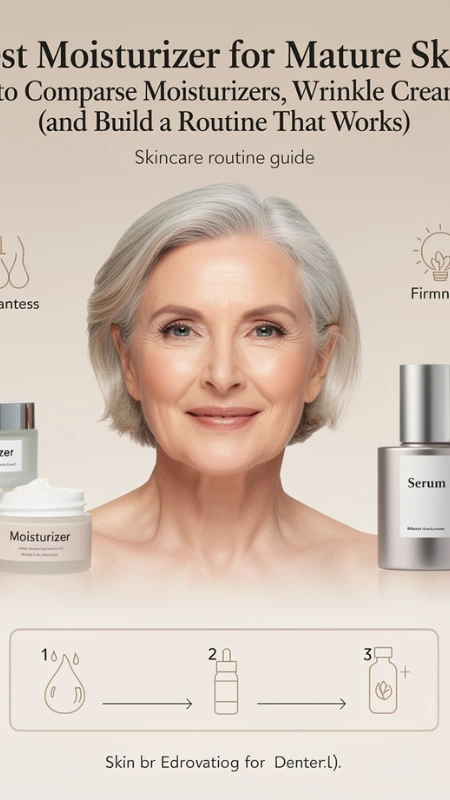
What Changes in Mature Skin (and Why Your Old Products Stop Working)
Mature skin isn’t a failure of skincare—it’s biology plus time. As you age, a few behind-the-scenes shifts make your skin behave differently:
- Your barrier weakens more easily. That means more water escapes (often discussed as transepidermal water loss), and you can feel dry even if you apply lotion.
- Natural lipids decline. You may notice rough patches, flaking, or that “paper-dry” feeling—especially around the mouth and cheeks.
- Collagen and elastin slow down. Fine lines linger longer; deeper lines become more noticeable.
- Cell turnover decreases. Your skin can look dull or uneven, and dark spots may hang around.
Dermatology organizations such as the American Academy of Dermatology (AAD) consistently emphasize barrier support and daily sun protection as foundational steps for aging skin. Research reviews indexed on PubMed also back common “gold standard” ingredients—especially retinoids and sunscreen—for visible anti-aging.
Moisturizer vs Wrinkle Cream vs Serum: What Each One Actually Does
Here’s the simplest way to think about these categories: they’re different tools, and your results improve when you stop expecting one tool to do every job.
Moisturizer (your comfort + barrier support)
A moisturizer’s main job is to:
- Hydrate and soften (humectants like glycerin draw water in)
- Smooth and cushion (emollients like squalane make skin feel supple)
- Seal and protect (occlusives like dimethicone help reduce water loss)
If your skin feels tight, crepey, or “thirsty,” your first priority is usually the best moisturizer for mature skin—not a stronger acid or another “active.”
Serum (your targeted treatment layer)
A serum is typically thinner and designed to deliver a focused ingredient (or a small cluster of them) such as:
- Vitamin C (brightness/antioxidant support)
- Niacinamide (tone + barrier support)
- Hyaluronic acid (plumping hydration)
- Peptides (firmness support)
- Retinoids (texture + wrinkles)
Serums are great—when you use the right one for your goal and don’t stack five at once.
Wrinkle cream (your richer treatment step)
A wrinkle cream is usually a cream-based treatment product that may contain:
- Retinoids or retinol
- Peptides
- AHAs (like lactic or glycolic acid)
- Supportive moisturizers
Wrinkle creams can overlap with moisturizers, but the difference is the intent: wrinkle creams are built to change the look of lines over time, not just make you feel comfortable today.
How to Choose Products Without Getting Pulled Into Marketing Hype
Instead of chasing the “newest” jar, compare products using criteria that actually matter for mature skin:
- Barrier support: ceramides, cholesterol, fatty acids, panthenol
- Hydration strength: glycerin, hyaluronic acid, urea (low %)
- Anti-wrinkle performance: retinoids, peptides, gentle acids
- Irritation risk: fragrance, essential oils, high alcohol
- Fit for your skin type: dry vs sensitive vs combination
- Day vs night practicality: layers well? pills? okay under SPF/makeup?
If you only remember one rule: the best moisturizer for mature skin is the one your skin tolerates daily and that keeps your barrier calm enough to benefit from treatments.
Best Moisturizer for Mature Skin: What to Look For (and What to Avoid)
Ingredients that tend to work well for mature skin
When you scan ingredient lists, these are consistently helpful:
- Ceramides + cholesterol + fatty acids: the “lipid trio” that supports the skin barrier
- Glycerin: dependable hydration that performs in real life (not just in a lab)
- Hyaluronic acid: helps plump dehydration lines (works best when sealed with a cream)
- Urea (low percentage): hydrates and smooths rough texture
- Squalane: soft, lightweight emollient—great when your skin feels thin or tight
- Niacinamide: supports barrier function and helps with uneven tone
What to be cautious with (especially if you’re sensitive)
- Strong fragrance or essential oils (a common reason “anti-aging” creams sting)
- High amounts of denatured alcohol (can feel weightless but worsen dryness)
- Too many exfoliating acids in one product (can trigger peeling and redness)
If your skin is reactive, you’re often better off with fewer actives and a stronger barrier focus.
Quick Comparison: Which Category Helps Most for Your Top Concern?
Use this as your “don’t overthink it” guide:
- Dryness/tightness/crepey feel: start with a moisturizer
- Fine lines + texture: add a retinoid wrinkle cream (usually night)
- Dullness + uneven tone: add a vitamin C or niacinamide serum
- Loss of bounce/firmness look: consider peptides (serum or cream)
- Sensitive and easily irritated: barrier-first moisturizer, then gentle actives later
Best Moisturizers for Mature Skin by Skin Type (What to Choose)
You don’t just need “a good moisturizer.” You need the right texture and ingredient balance for how your skin behaves now.
Mature dry skin: richer creams that seal in comfort
Look for:
- Ceramides + glycerin + a soft occlusive (like dimethicone)
- Cream or balm textures
- Fragrance-free if your dryness comes with irritation
Tip: If you wake up with dry patches, your moisturizer may be too light—or you may need to apply it to slightly damp skin.
Mature sensitive skin: barrier-first, low-drama formulas
Look for:
- Shorter ingredient lists
- Ceramides, panthenol, colloidal oatmeal
- No fragrance, no essential oils
Tip: If “anti-aging” products often sting, treat sensitivity as the main problem first. Calm skin looks younger than irritated skin.
Mature combination skin: hydration without greasiness
Look for:
- Gel-cream or light cream textures
- Glycerin + hyaluronic acid + squalane (a balanced trio)
- A moisturizer that layers well under sunscreen
Tip: You can moisturize more on the cheeks and less on the T-zone. Your face doesn’t need one uniform amount everywhere.
Best Wrinkle Creams for Mature Skin: What’s Worth Your Time
Wrinkles form for different reasons (movement, collagen changes, sun exposure), so “wrinkle cream” is a broad label. If you want visible improvement, focus on ingredients with real clinical support.
The most evidence-backed wrinkle ingredients
1) Retinoids (retinol, retinal, adapalene, prescription tretinoin)
Dermatology guidance often calls topical retinoids the most proven option for photoaging concerns like fine lines and texture. They can be irritating at first, so you’ll want a slow start.
2) Peptides
Peptides won’t replace retinoids, but they can be a smart choice if you want a gentler approach and your skin gets reactive easily.
3) AHAs (lactic acid, glycolic acid)
Helpful for glow and smoothness, but easy to overdo on mature skin. If you’re dry or sensitive, fewer nights per week usually works better.
4) Bakuchiol
Often marketed as a retinol alternative. Some people tolerate it well, but results vary and it’s not the same as prescription-strength retinoids.
How to use wrinkle creams without “angering” your skin
Try this approach:
- Start 2 nights per week for 2–3 weeks
- Move to every other night if your skin stays comfortable
- Add more only if you’re not peeling or stinging
The “buffer” method that helps many people:
Apply moisturizer → apply retinoid/wrinkle cream → apply moisturizer again (a “sandwich”). It can reduce irritation while you build tolerance.
Best Serums for Mature Skin: Pick One Goal, Then Choose One Serum
Serums can give you a big payoff—if you keep them simple.
Vitamin C serum (morning)
Why you might want it:
- Helps with dullness and uneven tone
- Antioxidant support (especially valuable alongside sunscreen)
What to look for:
- Opaque, air-restrictive packaging (vitamin C can degrade)
- A formula that doesn’t sting you daily
Hyaluronic acid serum (anytime you feel dehydrated)
Why you might want it:
- Plumps dehydration lines temporarily
- Adds a “fresh” look when topped with moisturizer
How to use it:
- Apply to slightly damp skin
- Always seal with moisturizer
Niacinamide serum (morning or night)
Why you might want it:
- Supports barrier function
- Can improve the look of uneven tone and redness
Peptide serum (night or morning)
Why you might want it:
- Adds a firmer, smoother look over time
- Often gentler than acids/retinoids
The Best Routine for Mature Skin (AM + PM) Using Moisturizer, Wrinkle Cream, and Serum
You don’t need a 10-step routine. You need a routine you’ll repeat.
Morning routine (simple and effective)
- Gentle cleanse (or just rinse if you’re dry)
- Serum (optional): vitamin C or niacinamide
- Best moisturizer for mature skin (barrier-supporting)
- Broad-spectrum SPF 30+ (daily, even when it’s cloudy)
If you’re serious about wrinkles, SPF is the quiet hero. The AAD consistently emphasizes sun protection as a core strategy for preventing visible aging.
Night routine (where most “change” happens)
- Cleanse (especially if you wore SPF/makeup)
- Hydrating serum (optional): hyaluronic acid if you feel tight
- Wrinkle treatment: retinoid or peptide-based wrinkle cream
- Moisturizer (more generous than morning)
If your skin is new to retinoids: keep everything else boring and soothing for a few weeks. That’s how you avoid the cycle of irritation → quitting → restarting.
DIY “Recipe” Options (Gentle, Barrier-Friendly) + Ingredient Tables
DIY can be comforting, but it’s not automatically safer. Patch test first, keep tools clean, and skip essential oils (they’re frequent irritants). If you have rosacea, eczema, or persistent burning, check in with a dermatologist.
Recipe 1: Simple Barrier Balm for Very Dry Patches (Night Use)
Ingredients table
| Ingredient | Amount | Why it’s included | Notes |
|---|---|---|---|
| Refined shea butter (fragrance-free) | 1 tbsp | Rich occlusive feel, softens rough areas | Can feel heavy on acne-prone zones |
| Squalane (olive or sugarcane) | 1 tsp | Lightweight slip + comfort | Good for mature dryness |
| Cosmetic-grade ceramide concentrate | As directed | Barrier support | Optional but helpful |
| Vitamin E (tocopherol) | 1–2 drops | Antioxidant support | Too much can feel greasy |
How to make/use
- Melt shea butter gently (double boiler method), stir in squalane and ceramides, cool, then add vitamin E.
- Use a pea-sized amount on very dry areas as your final step at night.
Recipe 2: Oat Soothing Mask (Rinse-Off for Sensitive Mature Skin)
Ingredients table
| Ingredient | Amount | Benefit | Notes |
|---|---|---|---|
| Colloidal oatmeal | 1 tbsp | Soothing, calming feel | Choose unscented |
| Filtered water (or cooled green tea) | Enough to mix | Helps create a paste | Keep it simple |
| Honey (optional) | 1 tsp | Humectant effect | Patch test first |
How to make/use
- Mix into a soft paste, apply for 5–10 minutes, rinse gently, then moisturize.
Common Mistakes That Keep Mature Skin Looking Drier (Even With Expensive Products)
If your skincare drawer is full but your face still feels tight, one of these is often the culprit:
- Over-exfoliating (daily acids, frequent scrubs): weakens barrier → more dryness lines
- Using hyaluronic acid without sealing it: can feel tight if water evaporates
- Starting too many actives at once: irritation masks any benefits
- Skipping SPF while using retinoids/acids: prevents progress and can worsen discoloration
- Fragrance overload: low-grade irritation can show up as redness, texture, and dryness
When to See a Dermatologist (So You Don’t Waste Months Guessing)
Consider professional help if:
- Your skin stings with most products
- Redness or flaking persists for weeks
- You suspect rosacea, eczema, or dermatitis
- You want stronger options (like prescription retinoids) safely
A dermatologist can guide you toward prescription treatments, gentler regimens, or procedures suited to your skin tone and sensitivity level.
FAQ: Best Moisturizer for Mature Skin, Wrinkle Creams, and Serums
What is the best moisturizer for mature skin if you have deep wrinkles?
Deep wrinkles rarely respond to moisturizer alone. The best moisturizer for mature skin will improve comfort and plump dehydration lines, but deeper lines usually need a long-game combo: daily SPF + a retinoid (if you tolerate it) + steady hydration.
Can the best moisturizer for mature skin replace a wrinkle cream?
Sometimes—but only if your moisturizer includes proven anti-wrinkle ingredients (like a retinoid or peptides at effective levels). Most moisturizers focus on hydration and barrier support, while wrinkle creams are designed for targeted change over time.
Should you apply serum or moisturizer first?
Serum first, moisturizer second. Your serum delivers the active ingredients; your moisturizer helps seal hydration and reduce irritation.
What ingredients should you avoid in the best moisturizer for mature skin?
If you’re dry or sensitive, be cautious with strong fragrance, essential oils, and high amounts of denatured alcohol. If you’re already using retinoids or acids, avoid piling on extra exfoliants in your moisturizer.
How long before you see results from wrinkle creams and serums?
Hydration can look better within days. Brightening and texture changes often take a few weeks. Retinoids typically require consistent use over a longer stretch. Your skin also needs time to adjust—especially if you’ve been irritated or over-exfoliating.
Your Next Step (A Simple Plan + Call to Action)
If you want a routine you’ll actually keep, do this for the next 14 days:
- Pick one best moisturizer for mature skin style product (barrier-focused, fragrance-free if needed).
- Use SPF every morning.
- Choose one treatment at night (peptides or a gentle retinoid) and start slowly.
Then pay attention to how your skin feels at 2 p.m.—that’s often the real test.
Now you: What’s your biggest mature-skin struggle right now—dryness, deep wrinkles, sagging look, or sensitivity? Share it, and I’ll suggest a simple moisturizer + serum + wrinkle-cream combo that matches your skin type and tolerance level.