
There’s a reason your heart skips a beat when a clean G-body glides past you at a stoplight. Maybe you remember riding in the back seat of your uncle’s Cutlass Supreme. Maybe you’ve spent weekends scanning classifieds, looking for the right Monte Carlo SS to park in your driveway. Whatever pulled you in, one thing is certain — g bodies have a presence that never really left the streets.
Table of Contents
If you’re curious about where the G-Body Cutlass came from, how it stacks up against other classic G-body vehicles, and whether one belongs in your garage, you’re in the right place. Let’s take a deep dive into the history, performance, collectibility, and lasting appeal of these rear-wheel-drive icons.
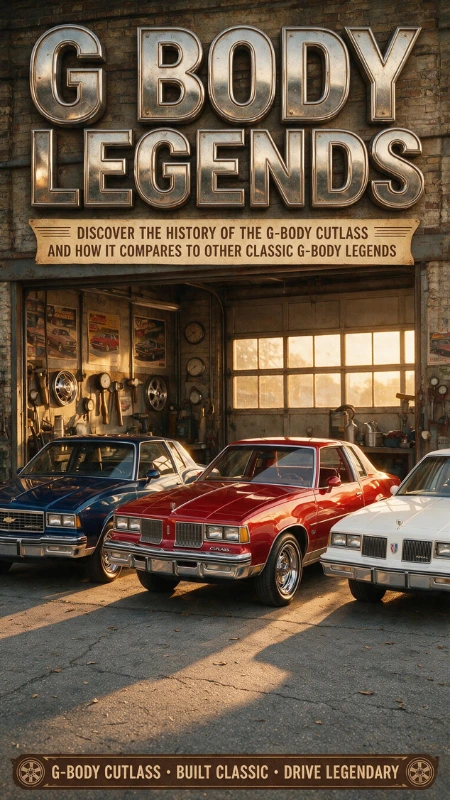
What Are G Bodies? Understanding the GM G-Body Platform
Before you choose your favorite, you need to understand what makes a car part of the g bodies family.
The G-body platform was introduced by General Motors in 1978 during a time when American automakers were under pressure. Fuel economy standards were tightening, insurance costs were rising, and the muscle car era of the early 1970s had cooled off. GM responded with a smaller, lighter, rear-wheel-drive mid-size platform that balanced efficiency and performance.
Key Characteristics of G Bodies
- Produced from 1978 to 1988
- Rear-wheel drive (RWD)
- Body-on-frame construction
- Available in coupes, sedans, and utility variants
- Shared platform across multiple GM brands
You’ll find several well-known nameplates built on this chassis:
- Oldsmobile Cutlass
- Buick Regal
- Chevrolet Monte Carlo
- Pontiac Grand Prix
- Chevrolet El Camino
- GMC Caballero
The beauty of the G-body platform lies in its versatility. Whether you wanted luxury, performance, or utility, there was a G body that fit your lifestyle.
The History of the G-Body Cutlass
If one model defined the era, it was the Oldsmobile Cutlass Supreme. At one point in the early 1980s, it was the best-selling car in America — not just in its class, but overall.
1978: The Beginning of the G-Body Cutlass
In 1978, Oldsmobile downsized the Cutlass onto the new G-body platform. You got a smaller footprint, improved fuel economy, and a cleaner, squared-off design that still feels unmistakably 1980s.
The Cutlass lineup included:
- Cutlass Supreme coupe
- Cutlass Salon
- Cutlass Calais
- Station wagon variants
It appealed to buyers who wanted comfort without stepping into a full-size sedan.
Performance Returns: 442 and Hurst/Olds Models
If you crave more than just cruising comfort, the performance trims are where things get interesting.
Cutlass 442 (1984–1987)
The 442 name returned with:
- 5.0L (307 cubic inch) V8
- Around 180 horsepower
- Dual exhaust
- Sport suspension
- Bold graphics and striping
While it didn’t match the firepower of late-1960s muscle cars, it delivered respectable performance for the era — and more importantly, it brought attitude back to the streets.
Hurst/Olds Revival
The Hurst/Olds edition added:
- Lightning Rod shifters
- Unique paint schemes
- Limited production numbers
If you’re hunting for collectibility, these limited editions deserve your attention.
Engine Options in the G-Body Cutlass
Over its production run, the G-Body Cutlass offered a range of engines:
| Engine | Displacement | Approx. Horsepower | Driving Feel |
|---|---|---|---|
| V6 | 3.8L | 105–110 hp | Smooth, efficient |
| Diesel V8 | 4.3L | ~90 hp | Economical but controversial |
| V8 | 5.0L (307) | ~140–180 hp | Classic V8 rumble |
| Performance V8 | 5.0L HO | Up to 180 hp | Stronger acceleration |
If you plan to modify your car, the 307 V8 is often swapped for a modern LS engine. The platform makes that transition surprisingly straightforward.
How the G-Body Cutlass Compares to Other Classic G Bodies
Now let’s see how the Cutlass stacks up against its siblings.
Buick Regal and the Grand National
When you talk about high-performance g bodies, the Buick Grand National dominates the conversation.
What Sets the Grand National Apart
- Turbocharged 3.8L V6
- Up to 276 horsepower in GNX trim
- 0–60 mph in under 5 seconds (GNX)
- Limited GNX production (547 units)
While your Cutlass 442 delivers classic V8 character, the Grand National hits harder in straight-line performance. Even today, it surprises modern cars.
Collectibility Comparison
- GNX models command six-figure prices.
- Standard Grand Nationals also bring premium values.
- Cutlass 442 values are rising but remain more accessible.
If you want exclusivity and raw acceleration, the Buick may be your pick. If you prefer affordability and timeless style, the Cutlass still wins hearts.
Chevrolet Monte Carlo SS
The Monte Carlo SS leaned into its racing identity.
Why the Monte Carlo SS Matters
- Aerodynamic nose design (post-1983)
- 5.0L V8 power
- NASCAR heritage
- Sportier visual stance
Compared to your Cutlass, the Monte Carlo feels more aggressive out of the box. The Cutlass, however, offers a more refined interior and luxury-oriented styling.
If you appreciate racing pedigree, the Monte Carlo deserves serious consideration.
Pontiac Grand Prix and the 2+2 Aerocoupe
The Grand Prix offered a middle ground between performance and comfort.
Grand Prix Highlights
- Distinct Pontiac styling
- 2+2 Aerocoupe sloped rear glass
- Limited production homologation model
The Aerocoupe was built to meet NASCAR requirements, making it one of the more unique G-body variants.
If uniqueness drives your buying decision, this one stands out.
El Camino and GMC Caballero: Utility with Muscle
Not all g bodies were coupes. The El Camino and Caballero combined car handling with truck utility.
You get:
- Rear-wheel-drive fun
- Cargo bed practicality
- Customization potential
In lowrider culture especially, these models remain popular.
Side-by-Side Comparison of Popular G Bodies
Here’s how the most desirable models compare:
| Model | Performance | Comfort | Collectibility | Best For |
|---|---|---|---|---|
| Cutlass 442 | Strong V8 | High | Growing | Balanced ownership |
| Buick GNX | Exceptional | Moderate | Extremely high | Investment collectors |
| Monte Carlo SS | Solid | Moderate | Strong | Racing enthusiasts |
| Grand Prix 2+2 | Moderate | Moderate | Niche high | Unique collectors |
Why G Bodies Are Still So Popular Today
If you’re wondering why these cars remain in demand decades later, consider this:
1. Rear-Wheel Drive Fun
Modern cars are dominated by front-wheel drive or all-wheel drive. G bodies keep things simple and engaging.
2. Easy to Modify
- LS swaps are common
- Aftermarket suspension upgrades
- Performance brake conversions
- Cosmetic restoration parts widely available
3. Affordable Entry Point
Compared to 1960s muscle cars, many G-body models are still attainable.
4. Cultural Influence
You’ll see them in:
- Hip-hop videos
- Lowrider shows
- Drag strips
- Social media builds
They’ve become part of American car culture.
Buying Guide: What You Should Look For
If you’re shopping for a G-Body Cutlass or another G body, here’s what to check.
Common Problem Areas
- Frame and floor rust
- T-top leaks
- Worn suspension bushings
- Sagging headliners
- Electrical gremlins
Price Ranges
| Condition | Average Price |
|---|---|
| Project | $3,000–$7,000 |
| Driver Quality | $8,000–$18,000 |
| Show Quality | $25,000+ |
| Rare Editions | $50,000–$100,000+ |
Always request documentation, especially for limited trims like 442, GNX, or Aerocoupe.
Are G Bodies a Good Investment?
Some models already show strong appreciation:
- Buick GNX: High six figures
- Grand National: Steady growth
- Cutlass 442: Gradual increase
- Monte Carlo SS: Solid demand
If you choose carefully and maintain originality, your car could appreciate over time.
FAQs About G Bodies
What are g bodies in classic cars?
G bodies are mid-size, rear-wheel-drive vehicles built by GM from 1978 to 1988, including the Cutlass, Regal, Monte Carlo, and Grand Prix.
Why is the G-Body Cutlass so popular?
The G-Body Cutlass was one of America’s best-selling cars in the early 1980s, offering a balance of comfort, performance, and reliability.
Which g bodies are the fastest?
The Buick GNX is widely regarded as the fastest factory-produced G body.
Are g bodies reliable?
With proper maintenance, many G bodies are dependable. Parts availability makes repairs manageable.
Is a G-Body Cutlass a good first classic car?
Yes. You benefit from strong aftermarket support, reasonable pricing, and simple mechanics.
Conclusion: Why Your Garage Might Need a G Body
When you look at the full picture — history, performance, culture, and value — it’s easy to understand why g bodies continue to captivate enthusiasts like you.
The G-Body Cutlass offers comfort, classic V8 character, and rising collectibility. The Buick Grand National delivers turbocharged intensity. The Monte Carlo SS brings racing flair. Each model tells a different story — and you get to decide which one fits yours.
If you’ve been thinking about owning one, now might be the time to act. Prices are climbing, and clean examples are getting harder to find.
Start researching listings. Visit local car meets. Talk to current owners. The right G body isn’t just a car — it’s a connection to an era you can still experience every time you turn the key.
Ready to find yours? Dive into the market today and claim your piece of G-body history before someone else does.