
You’ve carefully picked out a vitamin C serum, a retinol treatment, a hydrating toner, and a luxurious moisturizer. You apply them every single day — and yet, your skin just doesn’t look the way you imagined. Sound familiar? Here’s the hard truth: it’s probably not the products. It’s the order you’re putting them on.
Table of Contents
Skincare is more than a habit — it’s a ritual, a quiet act of self-investment that says I matter. But if you’re layering your products in the wrong sequence, you’re leaving real results on the table. This guide walks you through every single skincare step, backed by dermatologist insight, so you can stop guessing and start glowing.
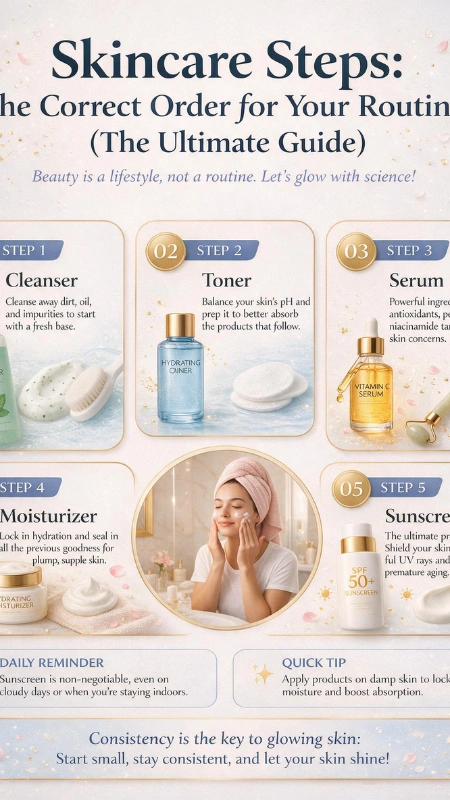
Why the Order of Your Skincare Steps Actually Matters
Before you reach for your first bottle, here’s something worth knowing: the order you apply skincare products in directly controls how much of each active actually reaches your skin, because each layer changes what the next one can pass through.
Think of your skin as a gatekeeper — it allows certain things in depending on what’s already sitting on its surface. The skincare application sequence you follow every morning and night can make a real difference in how well your products work. Apply things in the wrong order and even the best serum on the market may barely reach your skin.
Here’s the science behind it: active ingredients like retinol or vitamin E contain smaller molecular weights, so they are accepted by skin cells more easily. Ingredients with larger molecular weights, often present in creams, won’t pass through as easily.
So what’s the golden rule? When building a skincare routine, the general rule of thumb is to go from lightest to heaviest in consistency, gradually layering on heavier products like creams and lotions as you go — because the skin absorbs lightweight products quickly, allowing you to layer on more products easily.
The Morning Skincare Steps — Protect & Prevent
Your morning routine has one core mission: protect your skin from the day ahead. Every step should build toward defense — against UV rays, pollution, and environmental stressors.
Step 1 — Cleanser: Start With a Clean Slate
Your skin doesn’t just sit there all night doing nothing. It sweats, produces sebum, and collects residue from your pillow. That’s why cleansing is your non-negotiable first move.
Facial cleansers are a crucial first step in any morning routine; they can remove dirt, oil, and debris that your skin may have collected overnight — which isn’t possible with just a splash of water. By cleansing your skin, you’re also priming it so that it can absorb future products.
Cleanser is generally the first step — it helps remove excess oil, dirt, makeup residue, and other substances from the skin surface.
Quick Cleanser Guide by Skin Type:
| Skin Type | Best Cleanser Formula |
|---|---|
| Dry | Cream or milk cleanser |
| Oily/Acne-Prone | Gel or foaming cleanser |
| Sensitive | Fragrance-free, gentle formula |
| Combination | Balanced, low-pH gel |
| Normal | Any gentle, hydrating option |
💡 Pro Tip: Use lukewarm — never hot — water. Hot water strips your skin’s natural barrier and causes unnecessary dryness.
Step 2 — Toner: Balance and Prime
A lot of people skip this step, thinking it’s old-fashioned. But modern toners are far from the alcohol-heavy astringents of years past. Toners or essences replenish transient moisture stripped during washing and — in modern formulations — deliver humectants such as glycerin or hyaluronic acid that pull ambient vapor inward.
Put simply? Applying a toner after cleansing your face helps to restore your skin’s pH balance, making it better prepared to absorb the active ingredients in your serum or moisturizer.
How to apply your toner correctly:
- Pour a small amount onto clean palms or a cotton pad
- Gently press it into the skin — don’t drag or pull
- Allow it to fully absorb before moving to the next step
Step 3 — Serum: Your Targeted Treatment
This is where real transformation happens. Serums are the most concentrated step in your routine — highly active, deeply penetrating, and laser-focused on your specific skin concerns.
The first product layer will penetrate best, so whatever your main skin concern is, the active ingredient for that concern should go on first.
For the morning, a Vitamin C serum is your best ally. It brightens the complexion, fights free radical damage from pollution, and works synergistically with sunscreen to boost UV defense.
Morning Serum Cheat Sheet:
| Skin Concern | Best Serum Ingredient | Benefit |
|---|---|---|
| Dullness & Uneven Tone | Vitamin C | Brightens, antioxidant protection |
| Dehydration | Hyaluronic Acid | Pulls moisture into skin |
| Large Pores / Oiliness | Niacinamide | Regulates sebum, tightens pores |
| Redness / Sensitivity | Centella Asiatica | Soothes inflammation |
| Fine Lines | Peptides | Stimulates collagen |
💡 Tip: Apply your serum to slightly damp skin after toning — it helps the active ingredients absorb faster and more effectively.
Step 4 — Eye Cream: Don’t Neglect the Delicate Zone
The skin around your eyes is thinner, more fragile, and ages faster than the rest of your face. A dedicated eye cream targets dark circles, puffiness, and fine lines before they deepen.
How to apply it correctly:
- Use your ring finger — it naturally applies the least pressure
- Dot a pea-sized amount along the orbital bone
- Pat gently inward — never rub or drag
- Let it absorb before your moisturizer
Step 5 — Moisturizer: Lock in Everything You’ve Applied
Every skin type — yes, even oily skin — needs moisture. Skipping this step doesn’t control oil; it actually triggers your skin to produce more of it.
It’s super important that you use a moisturizer twice a day: once in the morning and once in the evening. Moisturizers lock in moisture and help prevent transepidermal water loss, or water evaporating from your skin.
First cleanse to remove impurities. Then use thinner, water-based products such as essences or serums. Finally, finish with thicker creams or oils to lock in moisture and provide a nourishing barrier.
Top moisturizer ingredients to look for:
- Hyaluronic Acid — attracts and retains water in the skin
- Ceramides — rebuilds and repairs your skin barrier
- Glycerin — lightweight humectant for all skin types
- Shea Butter — rich nourishment for dry and mature skin
Step 6 — Sunscreen: The Step You Should Never Skip
If there’s ONE skincare step you take away from this entire guide, let it be this one. Dermatologists everywhere recommend sunscreen every day — and that’s why it’s the final step of your skincare routine. You don’t have to wear sunscreen at night, but putting it on as the final step each morning is key to keeping your skin healthy and cancer-free.
Apply a broad-spectrum SPF 30 or higher — every single day, rain or shine.
⚠️ Common SPF mistake: Some moisturizers and makeup have sunscreen in them, but they’re usually not enough to completely protect you from sun damage. Always apply a dedicated sunscreen as your final step.
Morning Routine — Quick Reference Table
| Step | Product Type | Key Purpose |
|---|---|---|
| 1 | Cleanser | Remove overnight buildup |
| 2 | Toner | Balance pH, boost absorption |
| 3 | Vitamin C Serum | Brighten, protect, antioxidant |
| 4 | Eye Cream | Target dark circles & fine lines |
| 5 | Moisturizer | Hydrate & seal in previous layers |
| 6 | Sunscreen SPF 30+ | UV protection, anti-aging defense |
The Nighttime Skincare Steps — Repair & Renew
While you sleep, your skin enters its most powerful repair mode. Cell turnover accelerates, collagen is produced, and your skin barrier restores itself. Your nighttime skincare steps should feed directly into this biological process.
Step 1 — Makeup Removal
Never — and we mean never — skip this. Makeup, SPF, and daily grime form a stubborn film that a regular cleanser can’t fully remove on its own.
Begin your routine by removing makeup, sunscreen, and denser impurities like excess sebum with an oil cleanser. Oil attracts oil, effectively dissolving stubborn residues while leaving your skin nourished and soft.
Step 2 — Double Cleanse
Once your makeup is dissolved, follow with a water-based cleanser to sweep away the remaining residue. Follow with a cream, gel, foaming, or exfoliating cleanser to remove any remaining dirt, sweat, or water-soluble debris. This second cleanse ensures your skin is deeply clean and ready to absorb the next steps.
Step 3 — Exfoliate (2–3 Times Per Week Only)
Exfoliation helps clear the path for skincare products to be absorbed by removing dead skin cells that can block penetration.
However, more is not always better here. Over-exfoliation can strip your moisture barrier and cause redness, sensitivity, and breakouts.
Types of Exfoliants at a Glance:
| Type | Key Ingredient | Best Skin Type |
|---|---|---|
| Chemical AHA | Glycolic Acid | Dry, dull, aging skin |
| Chemical BHA | Salicylic Acid | Oily, acne-prone skin |
| Gentle AHA | Lactic Acid | Sensitive, dry skin |
| Enzyme | Papaya / Pineapple | All sensitive types |
Step 4 — Toner
Apply your toner the same way as the morning — pressing gently into clean skin to restore balance and prep for actives.
Step 5 — Treatment Serum (Retinol — PM Only)
Retinol is the crown jewel of nighttime skincare. It accelerates cell turnover, reduces fine lines, fades dark spots, and smooths texture over time. It’s photosensitive, which is why it belongs exclusively in the PM routine.
Retinol Beginner Tips:
- Start 2x per week and gradually increase
- Always follow with a rich moisturizer to reduce irritation
- Do NOT pair with AHA/BHA exfoliants on the same night
Step 6 — Eye Cream
Apply a richer, more nourishing eye cream at night. Look for ingredients like peptides, retinol (at low concentrations), and caffeine to target the deeper concerns while you sleep.
Step 7 — Moisturizer or Night Cream
A lot of skincare products — including retinol — can dry out your skin. That’s why your final evening moisturizer is critical. Choose a richer formula than your morning one — look for ceramides, peptides, and hyaluronic acid working together to restore, repair, and deeply hydrate overnight.
Nighttime Routine — Quick Reference Table
| Step | Product | Purpose |
|---|---|---|
| 1 | Oil Cleanser / Micellar Water | Dissolve makeup & SPF |
| 2 | Water-Based Cleanser | Deep clean pores |
| 3 | Exfoliant (2–3x weekly) | Remove dead skin cells |
| 4 | Toner | Rebalance & hydrate |
| 5 | Retinol Serum | Repair, anti-aging |
| 6 | Eye Cream | Overnight eye repair |
| 7 | Rich Moisturizer / Night Cream | Seal & deeply nourish |
Ingredient Combinations — What Works Together and What Doesn’t
Some ingredients can react when combined with other products. By following the correct order, you minimize the risk of unwanted interactions between your skincare products.
Safe Pairings ✅
| Combination | Why It Works |
|---|---|
| Vitamin C + Sunscreen | Amplifies UV defense |
| Retinol + Hyaluronic Acid | Reduces retinol dryness |
| Niacinamide + Moisturizer | Calms redness from actives |
| Peptides + Ceramides | Dual barrier repair |
Combinations to Avoid ❌
| Clash | Why to Avoid |
|---|---|
| Vitamin C + Retinol (same session) | Risk of irritation and instability |
| AHA/BHA + Retinol (same night) | Over-exfoliation, barrier damage |
| Benzoyl Peroxide + Retinol | Degrades retinol effectiveness |
| Two acids simultaneously | Strips moisture barrier |
Common Skincare Step Mistakes You Need to Stop Making
Morning or night, how you layer your skin care products affects which ingredients get absorbed by your skin. Apply them out of order, mix the wrong products, or use too many, and your skin will feel the consequences.
Here are the biggest mistakes that quietly sabotage your results:
- ❌ Applying products in the wrong order — blocks active ingredients from penetrating
- ❌ Skipping moisturizer if you have oily skin — triggers more oil production
- ❌ Over-exfoliating — destroys the skin’s protective barrier
- ❌ Forgetting sunscreen on cloudy days — UVA rays penetrate clouds
- ❌ Rubbing products in aggressively — causes micro-tears and irritation
- ❌ Stopping your routine at your jawline — your neck ages faster than your face
- ❌ Using too many actives at once — piling on extra products or following an extensive, multistep skincare routine does not actually yield more benefits
Skincare Steps for Your Specific Skin Type
Every skin type is different, and the right sequence can shift depending on whether you’re managing acne, sensitivity, dryness, or early signs of aging.
For Oily & Acne-Prone Skin
- ✅ Gel or foaming cleanser with salicylic acid
- ✅ Balancing toner with niacinamide
- ✅ Lightweight, oil-free serum
- ✅ Gel-based, non-comedogenic moisturizer
- ✅ Matte finish SPF
For Dry & Mature Skin
- ✅ Creamy, hydrating cleanser
- ✅ Essence or hydrating toner
- ✅ Hyaluronic acid + peptide serum
- ✅ Rich cream moisturizer with ceramides
- ✅ Hydrating SPF (labeled “with HA” or “moisturizing”)
For Sensitive Skin
- ✅ Fragrance-free, gentle cleanser
- ✅ Soothing toner with aloe or chamomile
- ✅ Centella asiatica or niacinamide serum
- ✅ Barrier-repair moisturizer
- ✅ Mineral sunscreen (zinc oxide) — gentler on reactive skin
Conclusion — Build Your Routine One Step at a Time
Your skin is with you every single day. It protects you from the world, tells your story, and reflects how well you take care of yourself. Getting your skincare steps right isn’t about buying more — it’s about being smarter with what you already have.
Whether you want a simple 3-step routine for the morning or a full 10-step regimen at night, the order you apply your products in matters. Start with the basics — cleanse, moisturize, and protect — then slowly build in targeted treatments as you learn what your skin responds to.
Stay consistent. Adjust with the seasons. Listen to your skin. And remember — the best skincare routine is the one you’ll actually stick to, done in the right order, every single day.
📌 Ready to level up your skincare game? Save this guide, share it with a friend who’s been complaining about their skin lately, and drop a comment telling us which step you’ve been skipping — we’d love to help you fix it!
FAQ — Skincare Steps: Your Most Asked Questions
Q1. What are the basic skincare steps I should follow every day?
The foundational skincare steps are cleansing, moisturizing, and applying sunscreen (morning). These three steps alone can dramatically improve your skin’s health when done consistently in the correct order.
Q2. In what order should I follow skincare steps for the best results?
Apply products in order of density, starting from the thinnest to thickest: toner, serum, moisturizer, sunscreen for day, and creams or oils for night.
Q3. Can I use retinol in my morning skincare steps?
No — retinol is photosensitive and should be reserved exclusively for your nighttime skincare steps. Using it during the day without very high SPF can cause irritation and reduce its effectiveness.
Q4. Do skincare steps differ for oily vs. dry skin?
Absolutely. If you have oily or acne-prone skin, choose a cleanser that contains ingredients like salicylic acid to remove excess oil, and a lighter, gel-based moisturizer. On the other end of the spectrum, those with dry or aging skin should look for hydrating cleansers and heavier, rich creams.
Q5. How many skincare steps do I really need?
There’s no magic number. A typical skincare order may include cleanser, toner or essence, serum, moisturizer, and sunscreen. However, not every step is essential for everyone. Start with 3–4 focused steps and build from there based on your skin’s needs.
Q6. Is the toner step in a skincare routine really necessary?
It’s not mandatory, but it adds value. Cleansing and toning help remove impurities and prepare skin for treatment. A hydrating modern toner can significantly boost the absorption of your serums and treatments.
🌿 Consistency beats complexity — every single time. Start your correct skincare steps routine today, and give your skin the care it truly deserves.